
Wieliczka Salt Mine
The Tourist Route at the Wieliczka Salt Mine goes down to 135 metres and covers about 3.5 kilometres with a guide. It starts at the Daniłowicz Shaft and runs through salt chambers, saline lakes and St Kinga's Chapel. UNESCO inscribed the mine in 1978; the 2013 boundary also takes in Bochnia Salt Mine and Wieliczka Saltworks Castle.
A royal mine UNESCO took off the danger list
The deposit at Wieliczka and Bochnia has been mined since the 13th century. UNESCO calls the undertaking the oldest of its type in Europe, and a royal one. The two mines were worked in parallel until the late 20th century as one company, the Kraków Saltworks, run from Wieliczka Saltworks Castle. The listed property is those three parts together. Wieliczka alone went on the World Heritage List in 1978. The boundaries were changed in a significant way in 2008 and again in 2013, which is when Bochnia and the castle joined the same entry. The criterion is (iv): mining technique in Europe from the 13th century to the 20th.
The galleries run to hundreds of kilometres, with chapels, statues and decoration cut in the salt. An underground tourist route has existed since the early 19th century. The mine was on the List of World Heritage in Danger from 1989 to 1998. Polish protection sits underneath the UNESCO entry: the historic-monument register number A-580 from 1976, and Monument of History status by presidential decree in 1994. Most of the preserved fabric is 18th century. The technical evidence is mainly 18th, 19th and 20th century. Earlier periods come largely from records and from reconstructions that are, in some cases, slightly over-interpreted.
Nearly 2,500 chambers, and the ones the route uses
The mine's chamber page says you will not find two identical excavations, and that there are nearly 2,500 of them. The Tourist Route is a short selection. In exceptional cases the operator drops some chambers from a given tour. Figures on the route page do not quite agree with each other: the practical box says about 3.5 kilometres, while the description of the walk says nearly 3 kilometres of galleries. Both lines are on the official Tourist Route page. The maximum depth on that walk is 135 metres. The average time is two to three hours, and that count includes the underground exhibition of the Cracow Saltworks Museum.
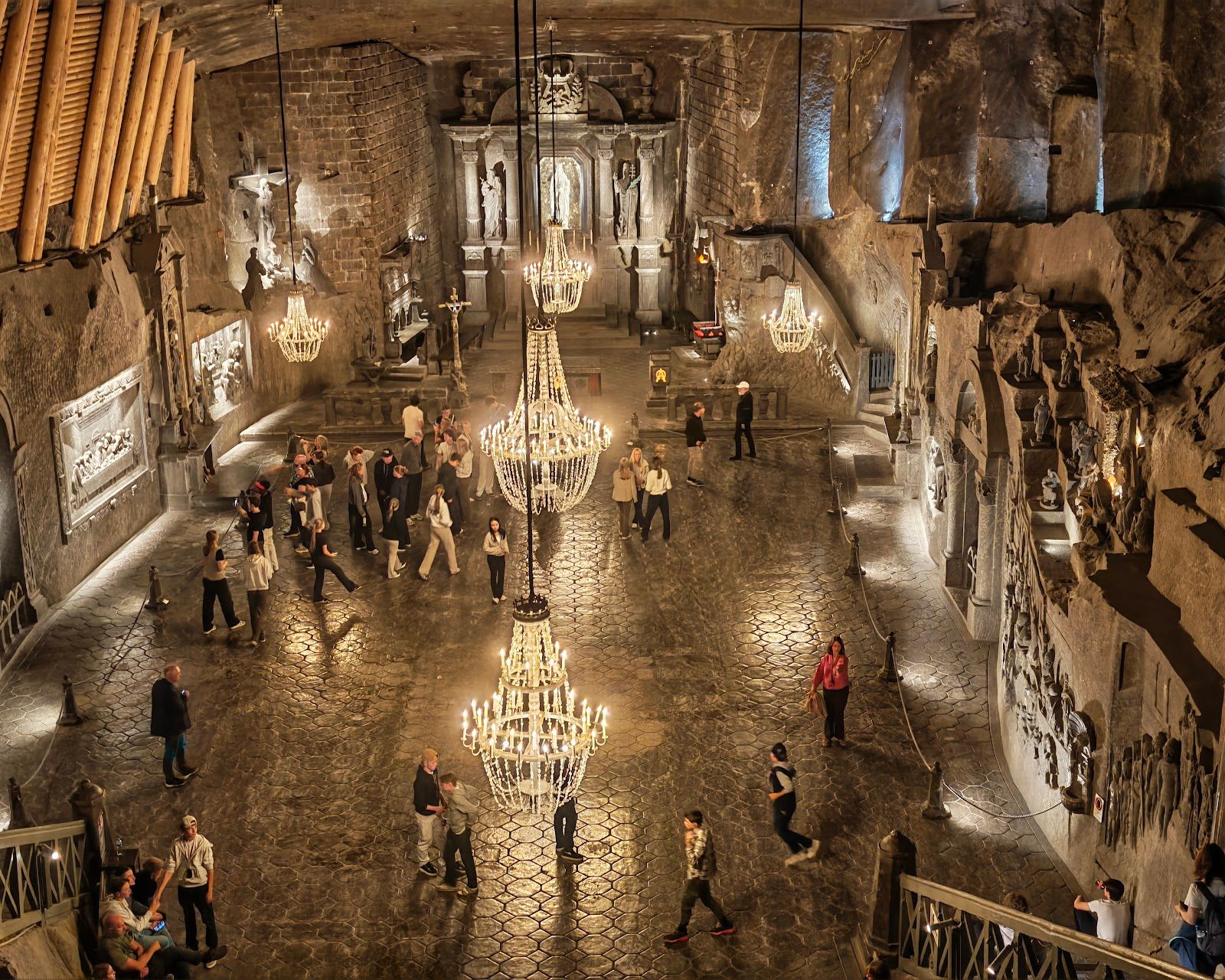
St Kinga's Chapel is the chamber the route page calls the most exceptional. The chamber page says the temple is said to have been made by three miner-sculptors, Józef Markowski, Tomasz Markowski and Antoni Wyrodek, and then corrects itself: other artists as well, because each new generation of miners keeps adding to the work. The story of Kinga, of how salt was found in Poland, and of an engagement ring is not printed there. The page places that telling in the Janowice Chamber and leaves it to the tour.
Michałowice was worked for over a century and is one of the largest chambers. The first Tourist Route, marked out at the beginning of the 19th century, ran through it. Those first guests came down the stairs by candlelight with a miners' orchestra. The Stanisław Staszic Chamber is 36 metres high. The same page ties an underground bungee jump and a hot-air balloon flight in that chamber to an entry in the Guinness Book of Records. Those are events in the chamber, not a stop the ordinary ticket describes.
Gołuchowski holds the station of an underground railway that Wieliczka had from the 19th century. The first rails were wood. The fear was that salt would destroy iron. The line carried salt ore and also tourists. Gospoda stored salt barrels. The name is the Polish word for a tavern, and the page only says that the barrels perhaps gave the chamber that name. Weimar has a brine lake. Pieskowa Skała, a chamber and not the castle of the same name, is where the route talks about how the workings are held up. Some researchers, the page says, think that without protection the mine could be gone in 160 years, because the excavations keep contracting.
In the Spalone Chamber the route takes up the penitents: men who moved bent low, in damp clothes, and burned methane before it could explode. If there was too much gas, one spark was enough. The page says that danger is no longer there. St Anthony's Chapel is one of the underground places of worship on the same walk. The Casimir the Great Chamber has a monument to the king, put up on the Tourist Route for the 600th anniversary of the Cracow Saltworks Statute. The chamber page says a third of the Polish treasury's income at the time came from salt, and that the statute is where Casimir regulated mining. It does not print the year of the statute. The Nicolaus Copernicus Chamber marks a named visit: the page calls him one of the first guests known by name, and a salt sculpture of him was unveiled on the 500th anniversary of his birth. Fortymbark was an underground stable. Horses are gone. The page names the last of them, Baśka, and does not give the year she went back to the surface.
Two chambers on that list are not on the Tourist Route. Boczaniec, with charred box cribs from a fire the page places over 300 years ago, is reached on the Miners' Route. So is the Franciszek Karol Chamber, named for an archduke who, the page says, worked underground for several hours in secret, dressed as an ordinary miner. A barrel of that day's output stood in the chamber for years. Practical mining tasks belong to the Miners' Route, not to the walk from the Daniłowicz Shaft.
What the walk itself is like
You go down at the Daniłowicz Shaft, Daniłowicza 10 in Wieliczka. A guide is with the group the whole way. The languages on the practical page are Polish, English, German, French, Italian, Russian, Spanish and Ukrainian, at set times and only while online tickets for that language remain. The group limit is 40. There is no minimum age. The operator says the walk does not require above-average fitness. It does include about 800 stairs, and 380 of them are at the start. The temperature on the route is 17–18°C. Photographs and filming are allowed.
Part way down, Karczma Górnicza sits 125 metres underground and serves Polish food and hot and cold drinks. The practical page also notes a changing table and special chairs there. On the surface, beside the Daniłowicz Shaft, Bistro Posolone serves salads, pizzas, burgers, pasta and coffee. Telephone signal does not reach the workings. The mine has set aside a place with free Wi-Fi, and a place to make calls. Toilets sit by the shaft before the tour, and in two places underground.
How to get there
Suburban train from Kraków Główny to Wieliczka Rynek Kopalnia, then a few minutes on foot to the Daniłowicz Shaft at Daniłowicza 10. Bus 304 from Dworzec Główny Zachód, near Galeria Krakowska, to Wieliczka Kopalnia Soli for that shaft, or to Wieliczka Rynek for the Regis Shaft. Use an agglomeration ticket for zones I and II.
FAQ
Is there a Tourist Route for wheelchair users?
Part of the Tourist Route is adapted for people with limited mobility. Those tours run every day at the first and the last opening hour, with a Polish- or English-speaking guide. Book by email at rezerwacja@kopalnia.pl. Places are limited. An assistance dog, or a guide for a blind or visually impaired visitor, may come into the mine.
Can I take a pushchair or a suitcase?
Pushchairs are not recommended because of the stairs. Only small cabin luggage is allowed on the tour, at most 20 by 20 by 35 centimetres. Larger bags stay in the coach or the car, in the luggage room of the Górnik building, or in an automatic locker if one is free. The lockers are limited and not guaranteed. Storage is free during touring hours.
Does the ticket let me enter at any time that day?
No. Tours run at set times. For a language other than Polish or English, the ticket has to be bought online beforehand. Tickets are also sold at the machine opposite the Daniłowicz Shaft and at the shaft ticket office if any are left that were not sold online.
Where can I leave the car?
Car park 1, Tężnia, is the larger one, at the Graduation Tower, with the entrance from ul. Dembowskiego 22. Car park 2, Daniłowicz, is by the shaft, entrance from ul. Daniłowicza 10, and the mine limits it to cars and motorcycles. The access page does not print a parking fee.
What is banned underground?
Open flame, electric torches, and smoking, including e-cigarettes. Animals are banned except service animals. The mine has nowhere to leave a pet.