
Wawel Royal Castle
Wawel Royal Castle in Kraków keeps Szczerbiec, the coronation sword used from Ladislaus the Short in 1320 through Stanislaus Augustus in 1764. The state rooms on the second story still hold Sigismund Augustus's Brussels tapestries, the only original decoration left in those Renaissance interiors. The museum, founded in 1930, presents the rooms as the royal residence of the 16th, 17th and 18th centuries.
The hill above the Vistula
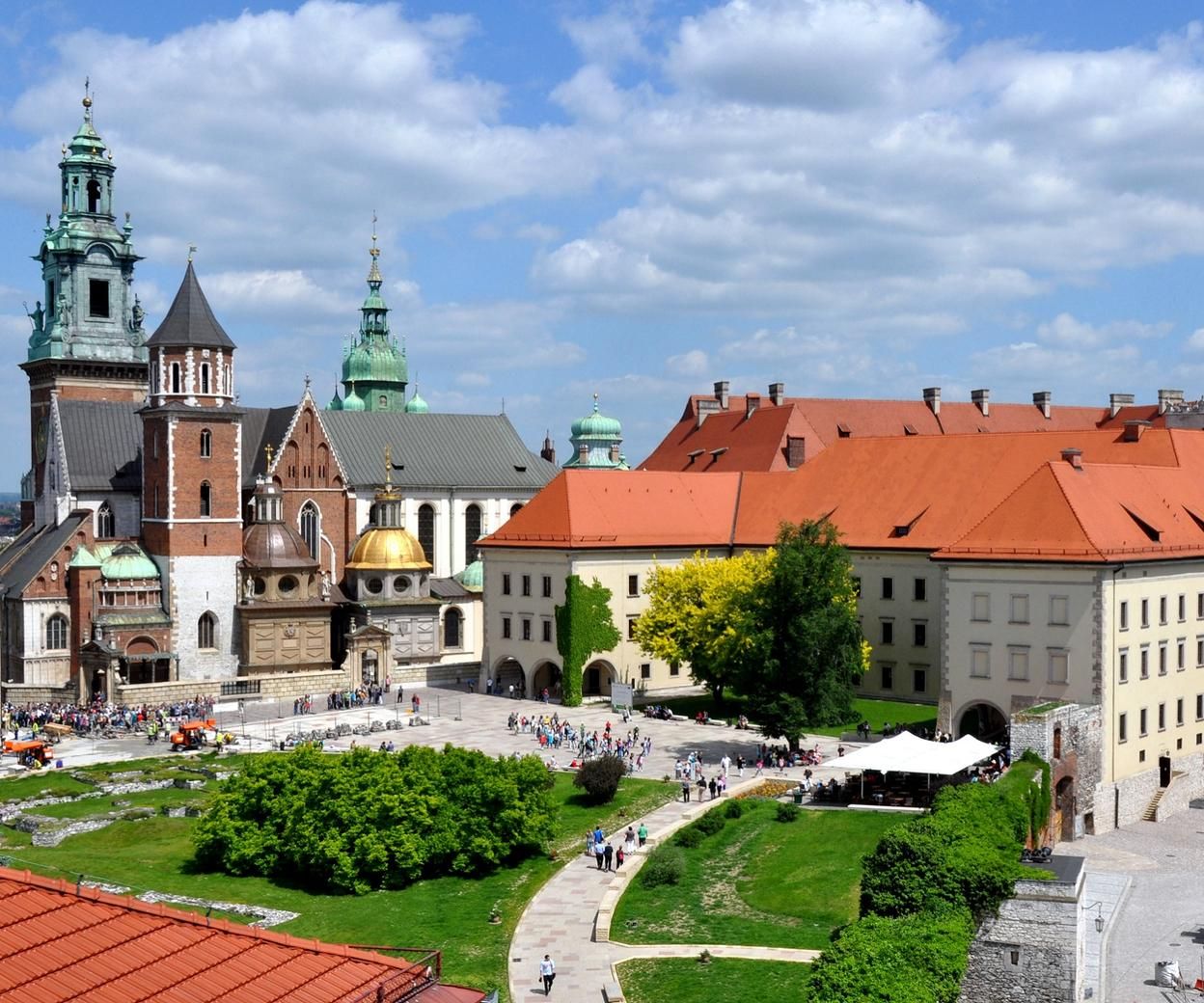
Wawel Royal Castle stands on Wawel Hill in Kraków. The museum describes the hill as Jurassic limestone formed about 150 million years ago, rising to nearly 228 metres, on the bank of the Vistula. People used it from the Paleolithic period. Slavic settlement is recorded from the 7th century, and by the 9th century it was the principal fortified settlement of the Vistulans. Mieszko I kept a residence here, as did Boleslaus the Brave. In the year 1000, when the bishopric of Kraków was established, a stone cathedral was built on the hill. Casimir the Restorer made Wawel a political and administrative centre. In 1320 Ladislaus the Short was crowned in the cathedral, the first coronation the museum records on this hill, and he was the first king buried there.
UNESCO places the Wawel Hill complex inside the Historic Centre of Kraków, inscribed in 1978. It calls the hill a former royal residence and necropolis, one of three ensembles with the medieval chartered city and Kazimierz, including Stradom.
From the palatium to the arcaded court
The residence began as a mid-11th-century Romanesque palatium. Its remains lie in the north wing of the present castle. Ladislaus the Short and Casimir the Great then built a Gothic complex around an irregular courtyard. Around 1504 Alexander commissioned a Renaissance palace, continued by Sigismund I the Old. Francesco Fiorentino, Master Benedict, Bartolomeo Berrecci, Niccolò Castiglione and Matteo the Italian worked on the fabric. The arcaded courtyard was finished about 1540. The museum treats those forms, drawn from ancient architecture, as the first of their kind used in Poland. In the 16th century both the sejm and the senate met in the castle.
After a fire in 1595, Sigismund III Vasa had part of the north wing rebuilt in early Baroque by Giovanni Trevano, with paintings by Tommaso Dolabella. Around 1610 the court moved to Warsaw, and later kings came back mainly for weddings, coronations and funerals. A second fire in 1702 destroyed ceilings, among them Dolabella's paintings in the Bird Room. After the partitions the Austrians turned the castle into a garrison and, in the early 19th century, bricked up the arcades. Troops left between 1905 and 1911. Restoration led by Zygmunt Hendel, then Adolf Szyszko-Bohusz, and after the war by Alfred Majewski, returned the courtyard. The museum itself dates from 1930. Its first gift, in 1882, was Jan Matejko's Prussian Homage, now on deposit at the National Museum in Kraków, so that canvas is not hanging in the castle.
State rooms and the Brussels tapestries
The official apartments are the piano nobile. In most palaces that is the first story. At Wawel the museum places it on the second. The rooms are higher than the ones below and were meant for sessions of the sejm and the senate, royal audiences, weddings and balls. Ten are currently on view. The Envoys Hall, also called the Heads Hall, held sejm sessions and in the 16th century served as throne room, presence chamber and ballroom, including the festivities at the coronation of Henri de Valois. Thirty sculpted heads remain in the coffered ceiling, all that survive of 193 carved about 1540 by Sebastian Tauerbach and Hans the Woodcarver. The Senators' Hall, called aula superior in the sources, was used for the state opening of the sejm. A musicians' gallery was added in 1592. The wedding of Bona Sforza and Sigismund I was celebrated in this room in 1518.
The tapestries commissioned by Sigismund Augustus were woven in Brussels in the third quarter of the 16th century, with biblical and grotesque scenes and the arms of Poland and Lithuania. The set ran to around 160 textiles. Of these, 140 exist, most of them at Wawel. They were taken to Russia in 1795, restituted after 1921 under the Treaty of Riga, evacuated to Canada in 1939, and returned in 1959–1961. The Baroque rooms rebuilt after 1595 now carry inter-war ceilings and walls covered with 18th-century cordovan leather. In the Bird Room, Ambrogio Meazzi's chimney piece bears the Polish arms and the Vasa sheaf. Around 1600, metal birds hung from that ceiling, which is where the room's name comes from.
Treasury, arms and the routes through the castle
The Crown Treasury exhibition stands where the state treasury stood. From the 14th century the crowns, sceptres, orbs and Szczerbiec were kept here, and only the king could send pieces out for a coronation or another state ceremony. The jewels were shown to the public for the first time in 1792. In 1795 Prussian troops emptied the treasury, and the crowns were melted down afterwards. The display rebuilt since 1930 can only evoke that loss. Szczerbiec, carried at coronations from 1320 to 1764, entered the museum in 1928. It is shown in the Jadwiga and Jagiello Room, a Gothic chamber of the late 14th century. The same route includes John III Sobieski's mantle of the Order of the Holy Spirit, from Louis XIV, and the consecrated sword and hat from Pope Innocent XI, with ceremonial silver from Gdańsk, Toruń, Vilnius, Augsburg, Hamburg, Nuremberg and Berlin.
The castle is several exhibitions, not a single walk. The second-floor route is the representative chambers. The October–December schedule also lists rooms on that floor where the Ottoman tents are presented. The museum calls this the largest collection of Ottoman tents in Europe, and its collections page says the tents are not on permanent display, for conservation. The first floor is the private apartments, together with the Porcelain Cabinet and Wawel Recovered. The ceramics department holds over 1,400 objects, including significant holdings of Meissen porcelain. Underground, the route pairs The Lost Wawel with the Lapidarium of stone sculpture and architectural fragments. The Armoury is separate. The museum describes its weapons, from the 13th century to the 17th, as one of the most valuable Polish collections of historic arms. Dragon's Den remains on the October schedule through 31 October.
Two temporary exhibitions are open on the current list. Anna Jagiellon: All the Faces of the Queen runs from 23 October 2026 to 14 February 2027. It treats the daughter of Sigismund the Old, sister of the last Jagiellon king and wife of Stefan Batory, as a ruler, founder and patron, and hangs a painting by Ewa Juszkiewicz in the chambers. Lares and Penates, on building a sense of security in architecture, runs from 24 September 2026 to 6 January 2027. From 6 November the schedule adds Ecstasies: Bernini at Wawel, centred on the bozzetto of the Face of Saint Teresa and drawings for the Cornaro Chapel altar. From 27 November it adds Vermeer's Woman with a Pearl Necklace, painted about 1663–1664, from the Gemäldegalerie in Berlin.
How to get there
About a 10-minute walk from the Main Market Square, or about 20 minutes from the main train and bus station. Tram stops: Wawel (Św. Gertrudy, at the foot of the hill) and Stradom (about 5 minutes). Bus stops: Stradom (about 5 minutes) and Jubilat (about 10 minutes). From the airport, agglomeration bus 300 stops at Jubilat or Rondo Grunwaldzkie.
FAQ
Is Wawel Royal Castle wheelchair accessible?
The external lift runs only with a member of staff. Ask the Reservation Office, Tourist Information or the ticket office before the visit, and call +48 12 422 51 55 ext. 219 if a car or taxi needs to come onto the hill. The First and Second Floors are accessible for the whole route, including electric wheelchairs. The First Floor route also includes Wawel Recovered, which is not accessible: the museum cites numerous narrow, steep steps. Dragon's Den is a steep winding staircase, and Sandomierska Tower takes 137 steps. Neither is accessible to wheelchair users or visitors with mobility difficulties.
Is there one ticket for the whole castle?
No. Each route is ticketed on its own. A combined Wawel for Enthusiasts ticket covers the exhibitions open that day at the castle plus selected areas of Pieskowa Skała Castle and Stryszów Manor House. Groups need to book tours in advance.
Are Monday visits free?
In October and December, Monday 10:00–16:00 has free admission to selected exhibitions, including the Castle Second Floor and the Crown Treasury. You still collect a free ticket, and the number is limited. Dragon's Den stays paid on that Monday list. In November, free-entry tickets for the Free November exhibitions go online one week ahead; on Mondays they are only at the ticket offices, from 8:45 am until they run out.
Can I bring a bicycle onto Wawel Hill?
No. The museum does not allow bicycles on the hill. Racks stand at both entrance gates. The castle is not responsible for damage or theft.
Is Sandomierska Tower open in late October?
The October schedule lists the tower on Saturday, Sunday and Monday, but it prints two end dates, 26 October and 31 October. Check the current What to See page for the day you go.