
St. Florian's Gate
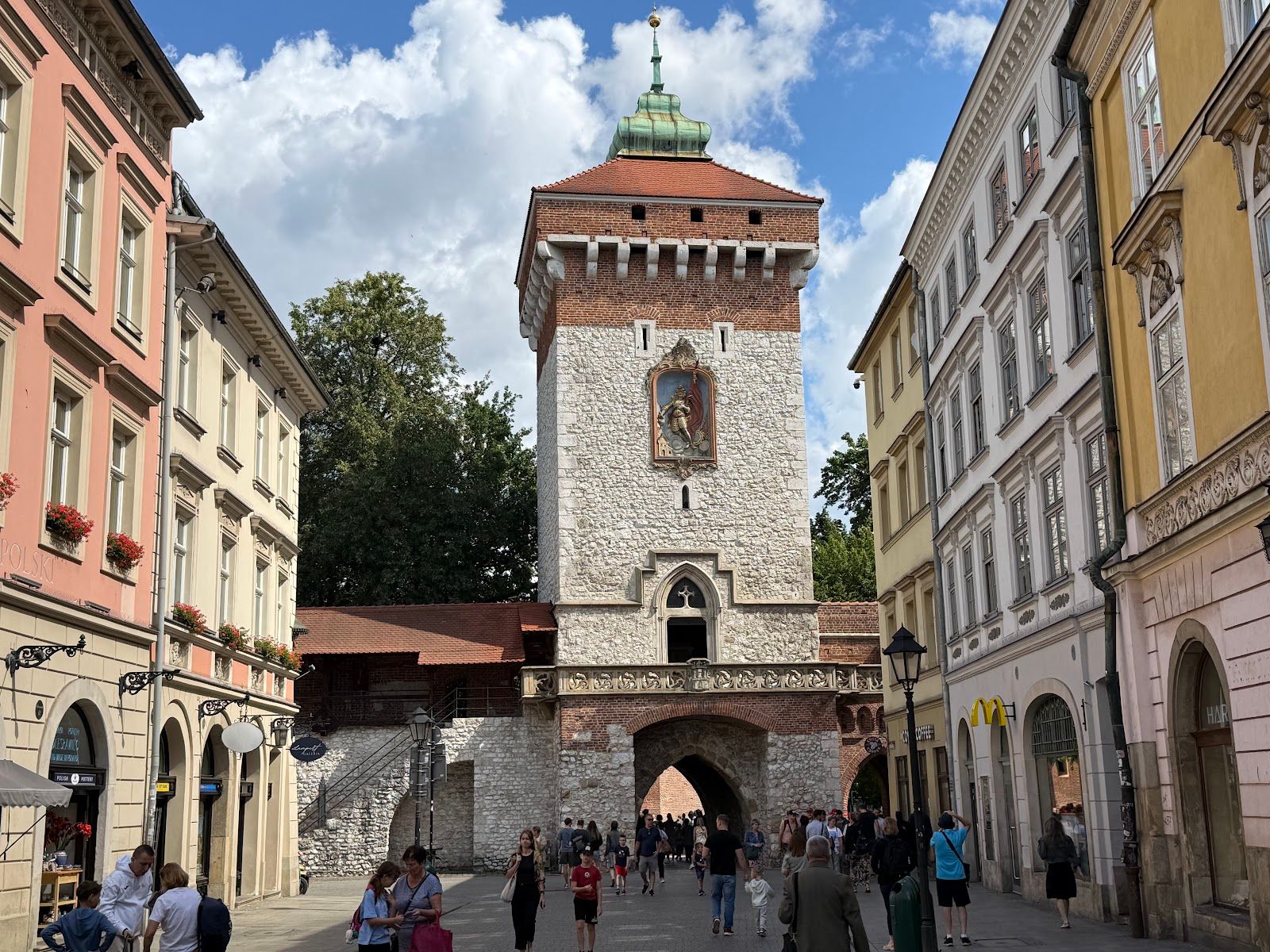
St. Florian’s Gate was the main city gate of medieval Kraków. The Museum of Kraków keeps it with three towers, the Haberdashers’, the Joiners’ and the Carpenters’, a fragment left after Emperor Francis II ordered the walls demolished in 1806. In 2026 the wall walk is open from 10 May to 30 October.
The gate that stayed when the walls came down
The Museum of Kraków describes the defensive walls, St. Florian’s Gate and three towers, the Haberdashers’, the Joiners’ and the Carpenters’, as a fragment of the medieval fortifications. The same museum text calls St. Florian’s Gate the main city gate. During a renovation in the 1880s a family chapel of the Czartoryski was built on the upper floor of the gate. The architect was Wandalin Beringer. In 1889 the bishop of Kraków, Albin Dunajewski, consecrated the chapel. The museum now hires that neo-Gothic chapel for weddings, engagements, occasional Masses and photograph sessions. The wall branch itself is the walk along this surviving northern stretch, at ul. Pijarska. The Barbican is a separate branch at ul. Basztowa, on the same northern line.
The morning opening of the city gate
On days the Barbican is open, the visit is preceded by the Ceremony of the Opening of the City Gates. After the bugle call from the tower of St. Mary’s at 10:00, a procession walks from the church along ul. Floriańska, through St. Florian’s Gate, to the Kleparz Gate. The people in it are the bugler, a museum representative in historical dress, and two city guards. At 10:20, at the Kleparz Gate, the city gate is opened to a melody. If ul. Floriańska cannot be used, the procession goes by ul. Szpitalna. The ceremony runs only on the days and in the hours the Barbican is open. The 2026 regulations set those days as 10 May to 30 October, Tuesday to Sunday, 10:30 to 18:00.
The street passage and the wall walk
The gate itself is the street passage at the north end of ul. Floriańska. That passage is not the museum walk. The walk, the walls branch at ul. Pijarska, is one direction. It uses stairs. The openings along it are window niches, and the regulations tell visitors not to lean over the railings or out of those niches.
The branch page lists an education walk, “In the footsteps of the defenders of Kraków”, for classes IV–VIII and secondary schools. It treats the walls and the Barbican as UNESCO-listed monuments.
What is left on the gate
The museum’s history of the branch dates the first written mention of St. Florian’s Gate to 1307, and takes the name from the church of St. Florian on Kleparz. In the 14th century it was a tall stone tower, nearly square in plan, with a simple rectangular foregate. A pointed-arch vault crosses the passage. Wooden gates closed it on the city side. On the outer side a wooden or iron grate rose and fell in stone guides. At the end of the 15th century, when the Barbican was built, the gate gained a brick storey with machicolations on stone corbels. For centuries a fortified neck joined the gate to the Barbican. Later the gate became the ceremonial entrance on the Royal Road. The building now stands 34 metres high. The decision to demolish the city walls is dated 1806. The demolition itself ran from 1810 to 1814, and into the first years of the Free City of Kraków. This stretch survived because Feliks Radwański senior (1756–1826), an architect, professor at the Jagiellonian University and a senator of the Free City, intervened.
On the outer face is a relief of the Piast eagle, made in 1882 to a design by Jan Matejko. On the city side is a Baroque relief of St. Florian. In the vaulted passage is a small altar of Our Lady of the Sands, moved there in 1835 from the neck that used to join the gate to the Barbican. On the upper floor, the Czartoryski chapel has a neo-Gothic balcony toward the city, designed in 1840 by Karol Kremer.
Only three towers remain beside the gate, joined by the stone wall. From ul. Szpitalna they are the Haberdashers’ Tower, the belt-makers, then the Joiners’ Tower, also called the Ropemakers’, and, by ul. Sławkowska, the Carpenters’ Tower. All three sit on a stone corbel and were raised in brick in the 15th century. The Haberdashers’ and the Joiners’ are semicircular on the upper floors, with machicolations and half-cone roofs. The Carpenters’ Tower is hexagonal in its brick part, under a pyramidal roof. It covered the city arsenal and the nearby Piarist church.
FAQ
Can an assistance dog, or a wheelchair, use the wall walk?
Assistance dogs of disabled people may enter. Other animals may not. The regulations do not describe a lift or a step-free route. There is no toilet and no cloakroom on the walls or in the Barbican.
Is a bus or tram printed for the gate?
No bus or tram line is printed on these pages. The visitor centre is 12 426 50 60, info@muzeumkrakowa.pl.
Does a Barbican ticket work on the walls the next day?
Yes, within 3 days of the date on the ticket, on days both are open, and the ticket also has a start time. Tickets from the machine, the walls desk and the visitor centre are not refunded. A guided booking has to be made at least 4 days ahead. Cancelling a guided visit with less than 4 days to go, or not arriving, draws a contractual penalty of PLN 250. Groups are at most 25 people.