
Polish Aviation Museum
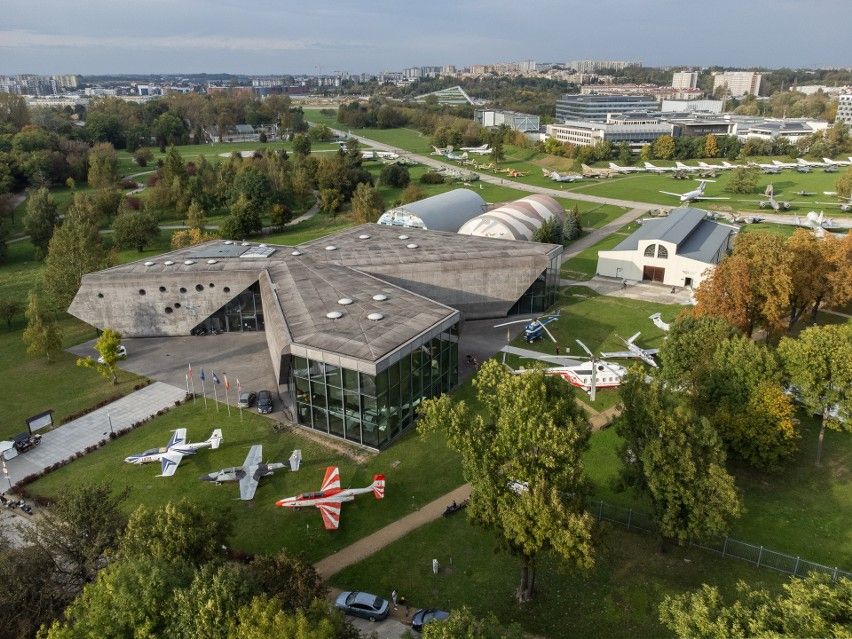
The Polish Aviation Museum holds 25.7 hectares of the former Rakowice-Czyżyny airfield in Kraków, taken over by Polish soldiers on 31 October 1918. The collection is over 250 aircraft, gliders and helicopters, and over 140 engines. Flying from the field ended in 1963, when Nowa Huta expanded.
An airfield that stopped flying in 1963
The museum stands on the old Rakowice-Czyżyny airfield. The history page says the Austrians of the partition set it up before the First World War, and Polish soldiers serving in Austro-Hungarian units took it over on 31 October 1918. The first k.u.k. Luftfahrtruppen aircraft appeared on the Rakowice fields in 1912, when Flugpark 7 was set up. Fliegerkompanie 7 formed on mobilisation on 21 July 1914. The Lower Pilot School, training the first pilots of independent Poland, opened on 11 May 1919. The 2nd Aviation Regiment formed on 11 August 1921. A civil aviation station opened on 18 July 1923, the start of passenger flying in Kraków. The double-nave concrete hangar was commissioned in 1925. The Academic Aero Club of Kraków was established on 1 February 1928. The regiment’s steel-concrete hangars came in 1929. The civil airport in Czyżyny opened in December 1931.
On 24 August 1939 the regiment was disbanded and the combat squadrons moved to field airfields. A German raid on 1 September 1939 damaged the building that is now the Main Hangar. German forces entered Kraków and took the field on 6 September 1939, then used and expanded it. In January 1945 they left, blowing up hangars, and Soviet air units took the field. Civil flying restarted on 16 March 1945. The 2nd Fighter Aviation Regiment was here from January 1946, and in July 1955 it moved to the new field at Balice. Reconstruction of two hangars and a concrete runway of 2,006 metres, begun by the Germans, was finished in 1953. Military flying ended on 23 March 1963, commercial flying on 15 October 1963, because Nowa Huta was expanding. The same year the military handed the ground to the Aero Club of the Polish People’s Republic for a museum.
How the museum was built on the field
The collection started as the Aviation Equipment Exhibition Centre of the Kraków Aero Club. From 23 August to 12 September 1964 it held the Great Aviation Exhibition for the 20th anniversary of the Polish People’s Republic. Aircraft brought in included machines from the Deutsche Luftfahrtsammlung in Berlin, left by the Germans at Kuźnica Czarnkowska in 1945. In 1967 the centre became the Aviation Museum, under the Supreme Technical Organisation, and the official opening was 31 August 1968. From 1 January 1971 it was under the Ministry of Transport, named the Museum of Aviation and Astronautics. After the 1998 local-government reform it is a cultural institution of the Małopolska Region. It now occupies 25.7 hectares on the historic register. What it started with was a small piece of the disused field, one hangar, an office building and the old parachute building. Later it took the former garages of the 2nd Aviation Regiment.
The charter job is to collect, protect, restore and show aviation technology, keep the character of the site, and run popular, educational and scientific work. The collection is over 250 aircraft, gliders and helicopters, in many cases unique, over 140 engines, and thousands of smaller objects: armament, cockpit instruments, uniforms and decorations. The shows sit in restored pre-war airfield buildings, in buildings put up while the museum has been operating, and in the open air.
Hangars you actually walk through
The engine exhibition opened in 1991 in a former regiment garage. The Small Hangar, for First World War aircraft, opened in 1992. In 2003 the exhibition “What You Do Not Know – Storerooms of History” opened in the next garage, with the oldest unrestored aircraft. That August, for the 40th anniversary, an aircraft landed again on the preserved runway and the Kraków-Czyżyny strip EPKC was registered. Two arched hangars were handed over in March 2005. One of them housed the Police Aviation Section from 3 May 2005. The NATO versus Warsaw Pact exhibition opened in the second arched hangar on 26 June 2009. The new Main Building, started in 2008, opened on 10 September 2010, with exhibition rooms, a library, a conference hall, a cinema and offices. “Wings of the Great War – Małopolska 1914–2014” opened in the modernised Small Hangar on 27 July 2014. “Wings and People of the 20th Century” opened on 16 March 2021 in the modernised Main Hangar, the garages and the parachute building. Hangar No. 5, on the site of the regiment’s historic hangar, was handed over and consecrated on 24 October 2024. The permanent exhibition “Upwind and downwind – Civil Aviation” opened on 23 August 2025. The accessibility page names that hangar “With the Wind and Against the Wind. Civil Aviation.” Construction of another hangar, the Hexagon project, started in April 2023. The page records the start, not an opening.
How to get there
Tram stop Muzeum Lotnictwa Polskiego on ul. Markowskiego: lines 4, 5, 9, 10, 52 and 75. Pedestrian access is from al. Jana Pawła II, along ul. Markowskiego, then past ul. Gnysia.
FAQ
Can a wheelchair get through the hangars?
The main building entrance is on the ground floor, with no stairs and no thresholds. The glass doors and walls are not marked with contrast tape. An elevator has Braille buttons and voice announcements. Wheelchairs, magnifying glasses and noise-cancelling headphones can be borrowed at the ticket office, and there is a tactile map beside it. Guide dogs may enter. The outdoor ground is level and paved, but the road through the outdoor show to the civil-aviation hangar is uneven. The Great War hangar is reached by wheelchair through the door on the Aleja Migów side. There is no sign-language interpreter on site. An assistant, or an induction loop for a group of up to 19, needs an email at least two days ahead to sylwia.przywora@muzeumlotnictwa.pl or a call to 789 059 943.
Where can a disabled visitor park?
With a disability card you can drive up to the main building. That area is not open to the public. Reserve it on 669 706 581, or with the accessibility coordinator on 789 059 943. Two disabled bays are on the Markowskiego car park and one is on Gnysia. Ordinary parking on Markowskiego, Gnysia and the access road is free. Two electric carts, seven seats each, cover the outdoor grounds if you book on 12 642 87 00 ext. 115 or ilona.cygan@muzeumlotnictwa.pl.
Which bus is closest if the tram is not the plan?
The Ugorek stop on ul. Ułanów, near ul. Seniorów Lotnictwa, is 650 metres away. Lines there are 124 and 424. TAURON Arena Kraków Wieczysta on al. Jana Pawła II is 1.4 kilometres, with lines 124, 128, 424 and night line 664. Bora-Komorowskiego has 159, 172, 501, 502, 511 and night line 608. Bicycle racks stand in front of the Main Building. The address is al. Jana Pawła II 39, 31-864 Kraków.