
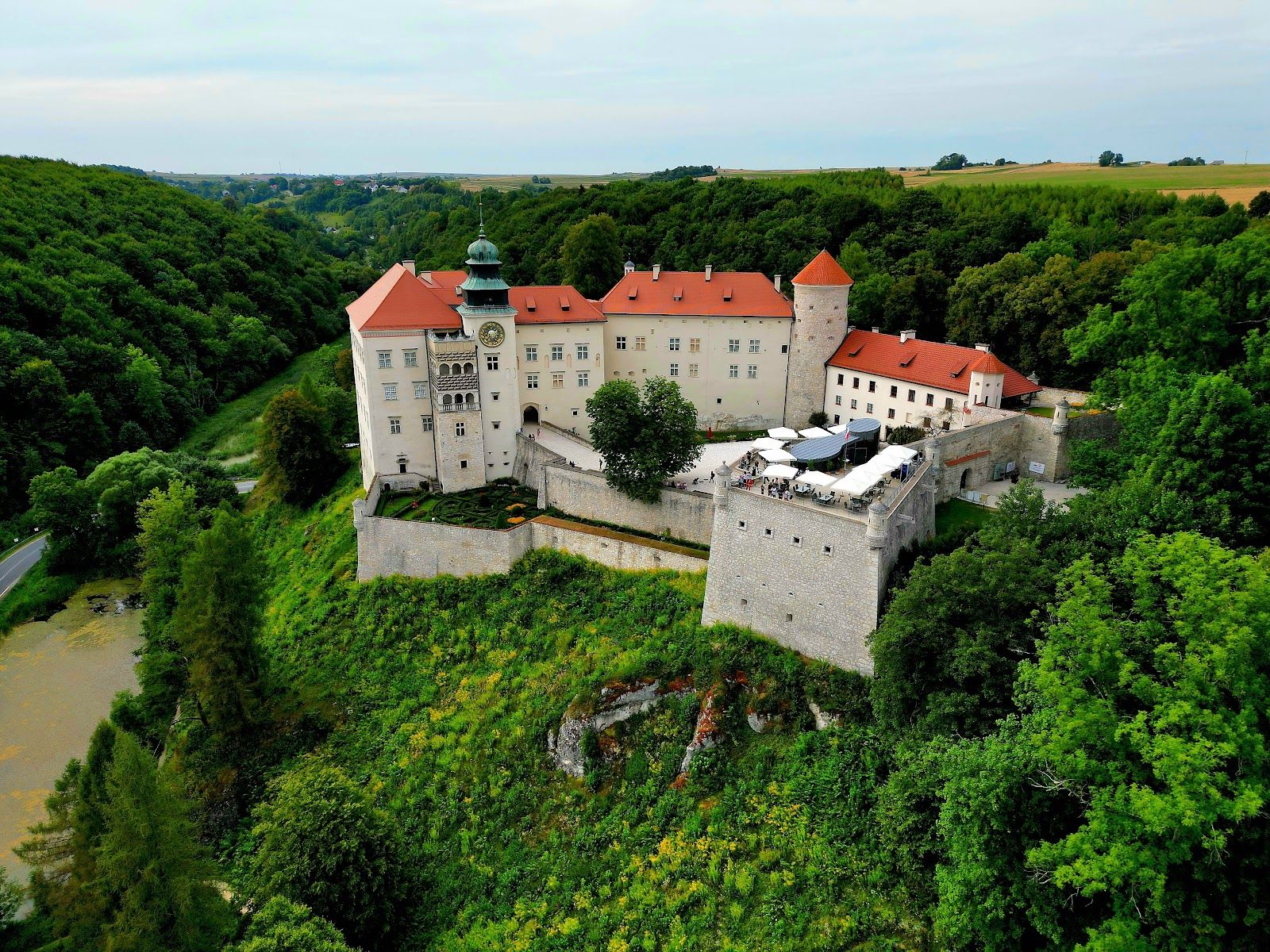
Pieskowa Skała Castle
The oldest written notice of Pieskowa Skała is a 1315 document of Władysław Łokietek that calls the castle Peskenstein. Kazimierz the Great built the present site in the first half of the 14th century, on a rock spur above the Prądnik valley. The gallery, a branch of Wawel, opened in 1970.
From Peskenstein to a royal watch on the rock
The castle history page dates the oldest notice to 1315. Władysław Łokietek’s document uses the German-sounding name Peskenstein. The page links that notice to fortifications found by Stanisław Kołodziejski in nearby Sułoszowa, most likely raised by Henry the Bearded during the fight for the Kraków throne, to watch the road from Kraków to Silesia down the Prądnik valley. The new castle, on the site used now, was built by Kazimierz the Great in the first half of the 14th century. It stood on a rock spur and the steep slope, in an upper and a lower part. The upper castle, gone now, sat on the rock called Dorotka today, with the highest tower, still used as a dwelling in the 15th century. The lower castle stood where the Renaissance courtyard is, with service buildings around a yard inside defensive walls. The castle stayed royal until the end of the 14th century.
In 1377 King Louis of Hungary gave it to Piotr Szafraniec of Łuczyce, the deputy pantler of Kraków, as compensation for a wound he took in a quarrel with the king’s Hungarian courtiers. Władysław Jagiełło confirmed the gift twice and then passed the castle in perpetuity to Piotr’s son, also Piotr. That younger Piotr, voivode of Kraków, and his brother Jan, bishop of Kujawy and crown chancellor, were close advisers of Jagiełło. A letter of Duke Vytautas accuses Jagiełło of holding private councils with the two Szafrańce. Later generations spent the fortune and lost their standing. The page says that if one believes 15th-century rumours passed on by Długosz, the third Piotr practised alchemy and black magic in the castle. His younger son Krzysztof was among the best-known Polish robber-knights. In 1484, on the order of King Kazimierz Jagiellończyk, he was caught, tried and beheaded. The 15th century still added to the defences: two large round artillery towers on the east side.
The Renaissance courtyard, then the brick-up
In the 16th century the owners were back at court. Hieronim Szafraniec had the trust of Sigismund the Old, who made him secretary and married him to his natural daughter Regina. The wedding was at Wawel. The dowry let Hieronim start rebuilding Pieskowa Skała, using Italian builders after the Renaissance rebuilding of Wawel. He did not finish. The page credits the present residence mainly to his nephew Stanisław Szafraniec, voivode of Sandomierz and a protector of Polish Protestants, who founded Calvinist churches and schools and supported Mikołaj Rej. Under Stanisław the castle gained an arcaded courtyard and a viewing loggia. The courtyard ornaments were naturalistic mascarons, cartouches with the coats of arms Starykoń, of the Szafraniec family, and Rawicz, of his wife Anna Dębińska, and portals. Franciszek Siarczyński is quoted: Stanisław raised a splendid castle, planted gardens, and laid out ponds and menageries. After the last Szafraniec, Jędrzej, died in 1608, the estate passed to Maciej Łubnicki.
In the first quarter of the 17th century the castle changed hands several times and became the residence of Jan Zebrzydowski, the crown sword-bearer. His son Michał, starost of Lanckorona and voivode of Kraków, built a chapel of St Michael in the north wing and new eastern fortifications in the new-Italian bastion system, closing a large outer courtyard. They were not enough. In 1655 the Swedes took, damaged and robbed the castle. Around the middle of the 17th century it belonged to the Wielopolski family. Jan Wielopolski ran the royal salt mines at Wieliczka and Bochnia. His descendants called themselves counts of Pieskowa Skała and came mainly to hunt. Hieronim Wielopolski, in the second half of the 18th century, moved there for good. He had a joinery and a forge. A fire in 1718 had damaged the castle. He repaired it, bricked up the Italian arcades, which the page says did not suit the Polish climate, closed the loggia, and gave the towers onion domes. Interiors were hung with coloured tapestries, and Turkish, Persian and paradise rooms were fitted. In 1787 King Stanisław August Poniatowski was a guest.
Fire, the January Uprising, the boarding house, Wawel
From 1842 the castle belonged to the Mieroszewski family. Jan kept his library and a collection of antique gems there. Under his son Sobiesław it was damaged twice. A fire in 1850 led, three years later, to the collapse of the oldest part, the Casimir upper castle on Dorotka rock. Repairs were unfinished when, on the night of 3 to 4 March 1863, during the January Uprising, combined units of generals Langiewicz and Jeziorański, sleeping in the castle, were surrounded by tsarist troops. The insurgents broke out toward Skała. The Russians occupied the empty castle. Local peasants, stirred up by the partitioning power, finished the destruction. Sobiesław’s repairs gave the castle a neo-Gothic look: crenellation on the round bastion, decorative turrets, and the loggia bay turned into a large tower with a pyramidal roof. At the end of the 19th century the family sold the neglected castle. A joint-stock company formed to save it, led by Adolf Dygasiński and Dr Józef Zawadzki, with shareholders from Warsaw families, bought it for an exclusive boarding house. The page ties the Warsaw link to the post-Napoleonic border: the Prądnik valley and the castle lay in the Congress Kingdom. The boarding house ran from 1903 to 1939. Under German occupation the owners opened the hotel rooms as an orphanage, through which hundreds of children passed, mostly from the former eastern borderlands.
After the war the castle was nationalised and given to the Ministry of Agriculture. In 1950 the Ministry of Culture and Art took it. Professor Alfred Majewski directed architectural research that uncovered Renaissance architecture and decoration and reconstructed the 16th-century arcaded courtyard and the viewing loggia. The State Art Collections at Wawel were given the building. Because the interiors and records of how they looked had not survived, Professor Jerzy Szablowski planned a gallery of part of the Wawel treasures, showing European art from the Middle Ages to the 19th century. Professor Adam Młodzianowski designed it. The exhibition opened in 1970 and ran until 1994. After a renovation in 1994–2004, a new display opened on both floors in 2005, designed by Małgorzata and Maciej Radnicki. In 2014–2016, with a state grant and support from Iceland, Liechtenstein and Norway through the Norway and EEA funds, Majewski’s work was taken up again.
How to get there
The castle lists private buses and line A13, a feeder of Koleje Małopolskie. It does not name the stop. By car, national road 773 from Skała, Ojców or Olkusz. The accessibility page calls the same road voivodeship road 773, Sieniczno–Wesoła.
FAQ
Which rooms can a wheelchair enter?
Both courtyards are level and open to disabled visitors. Assistance dogs may enter. The ticket office, information desk, shop, restaurant and viewing terrace in the south bastion have had their barriers removed. A free adapted toilet is in that bastion. Another adapted toilet is on the ground floor at the entrance to Old Polish Culture, and that exhibition is also adapted for blind visitors. Single disabled visitors can be admitted to the first-floor rooms of European Styles. The second floor of that exhibition, the English interiors, and the History of Pieskowa Skała exhibition are not accessible. There is no voice information, no induction loop, and no sign-language interpreter. A drop-off by the asphalt road from Wielmoża can be arranged on 12 389 60 04.
Where do I leave the car?
The castle has no car park and no driving onto the grounds or into the park. Ojców National Park car parks sit at the junction of the roads to Skała, Sułoszowa and Wielmoża, and on the Skała side under Hercules Club, on the bend of the Prądnik. Private car parks are at the Glanowski farm, Podzamcze 2, and at the campsites Nasza Polana and Nasza Dolina. From the main park car park the pedestrian stairs are not usable by wheelchair or by a larger pram. A dirt road is usable with a pram and too steep for a wheelchair. From Wielmoża, about 1 kilometre away, an asphalt road has no barriers and is closed to cars. The accessibility page puts the castle 25 kilometres from the centre of Kraków.
What is free on a Monday in October?
Individual entry to History of Pieskowa Skała and to Old Polish Culture with the crypt and chapel, from 9:30 to 15:00, last entry 14:00. The outer courtyard is open 9:00–17:00. The paid Castle, Noble Times and Welcome routes are the Tuesday-to-Friday pattern. Children aged 0–7 are free, and a temporary exhibition in the cellars is included with every ticket. Groups need a booking. Transfer payments must be arranged at least 7 days ahead, on 12 389 60 04 or pieskowaskala@wawelzamek.pl.